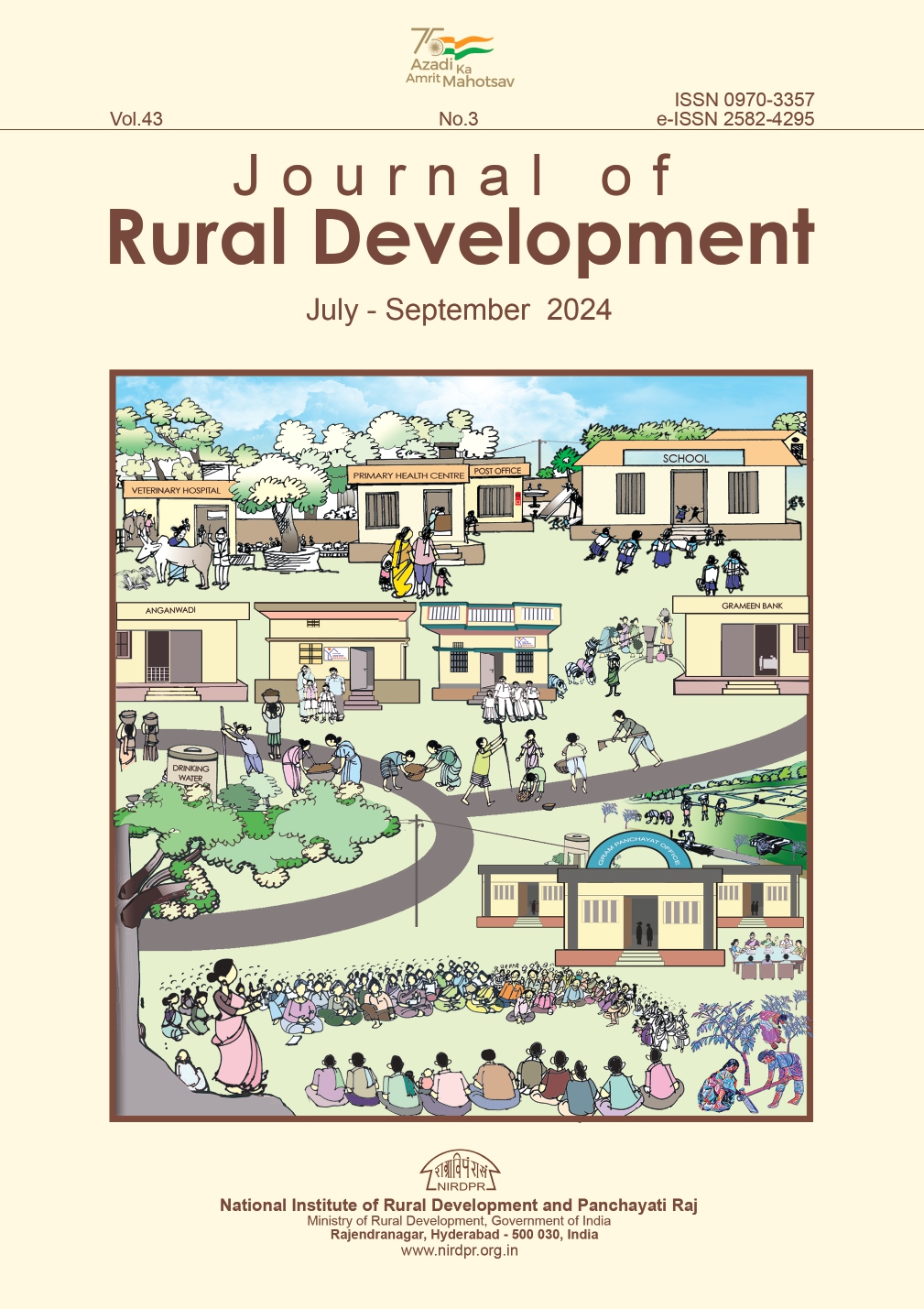
Decentralised Governance: Perceptions of Depressed Class Gram Panchayat Members in Karnataka
DOI:
https://doi.org/10.25175/jrd/2024/v43/i3/172579Keywords:
Decentralisation, Gram Panchayat Members, Karnataka.Abstract
Decentralisation of power is visualised as one of the ways to recognise the rights of the depressed class (Scheduled Caste-SC and Scheduled Tribe-ST) and women through affirmative action realised in terms of reservation of seats. Through participation in decision-making, these groups can address the community’s needs, fight for their rights, and question discrimination. This study follows a qualitative approach to understanding the transition process and challenges gram panchayat (GP) members, particularly SC men and women, face in political administration and participation. Social discrimination based on caste has faded over the years, but a few SC GP members reported that they were still unable to enter the temples. Many upper caste leaders and landlords allow SCs to enter their houses up to the veranda, but there are strict restrictions on entering the kitchen. In the initial years of their representation, the GP members did not know about their mandatory functions, transfer of funds, sponsored schemes, etc., but attributed their current level of knowledge to training programmes given by the government and other allied agencies. Members feel that reservation has helped them to enter politics but has contributed little to improving their social status. Decentralisation has given them an opportunity to work for their community and wards. Despite various training programmes, most of the members were unaware of social auditing and gender budgeting, both of which are crucial in terms of transparency and maintaining balances in GP. Members have realised the importance of education based on their difficulties in understanding the process and intervention in many GP activities. Since more than half of the female members participating in the focus group discussions (FGDs) had not entered the schools, they remained silent spectators in many actions of GP and their role was nominal. Along with all probabilities, they were still confident of winning the election for their second term.
Downloads
References
Aziz, A. (2000, May 23–27). Democratic Decentralisation in Karnataka: Past and Future. International Conference on Democratic Decentralisation, Thiruvananthapuram, Kerala, India. http://decwatch.org/files/icdd/044.pdf
Bardhan, P., & Mookherjee, D. (2007). Corruption and Decentralisation of Infrastructure Delivery in Developing Countries. University of California, Berkeley. Available at
Baviskar, B. S., & Mathew, G. (2009). Introduction. In Inclusion and Exclusion in Local Governance: Field Studies From Rural India (pp. xx–xx). Sage Publications.
Beaman, L., Duflo, E., Pande, R., & Topalova, P. (2011). Political Reservation and Substantive Representation: Evidence From Indian Village Councils. Policy Forum, NCAER, 159–201. https://www.ncaer.org/uploads/2022/09/4_L
Behar, A., & Kumar, Y. (2002). Decentralisation in Madhya Pradesh, India: From Panchayati Raj to Gram Swaraj (1995 to 2001) (Working Paper No. 170). Overseas Development Institute.
Bhargava, B., & Subha, K. (2009). Including the Excluded Through Panchayati Raj in Karnataka. In Inclusion and Exclusion in Local Governance: Field Studies From Rural India (pp. 169–197). Sage Publications.
Buch, N. (2000). Women’s Experience in New Panchayats: The Emerging Leadership of Rural Women (Paper No. 35). Centre for Women’s Development Studies.
Chattopadhyay, R., & Duflo, E. (2004). Women as Policy Makers: Evidence From a Randomized Policy Experiment in India. Econometrica, 72(5), 1409–1443.
Crook, R., & Manor, J. (1998). Democracy and Decentralisation in South Asia and West Africa. Cambridge University Press.
Decentralisation Analysis Cell. (2009). Tribal Population in Gram Swaraj Project Area – Their Inclusion and Fiscal Devolution in Panchayat Raj Institution: An Empirical Study. Rural Development and Panchayati Raj Department, Government of Karnataka.
Gochhayat, A. (2013). Political Participation of Women in Gram Panchayat Elections in Odisha: A Case Study of Hindol Block in Dhenkanal District. International Journal of Humanities and Social Science Invention, 2(2), 38–46.
Goetz, A. M. (2007). Political Cleaners: Women as the New Anti-Corruption Force? Development and Change, 38(1), 87–105.
Jackson, C. (1999). Social Exclusion and Gender: Does One Size Fit All? European Journal of Development Research, 11(1), 125–146.
Kumar, S., & Pawar, P. (2003). Dalit Leadership in Panchayats: A Situational Analysis of Maharashtra. PRIA, 9(26), 12–15.
Lakwo, A. (2009). Making Decentralisation Work for Women in Uganda (Vol. 16). African Studies Centre.
Makwana, R. (2012). Women Empowerment Through Panchayati Raj. ABD Publishers.
Rai, M. (2003). Mainstreaming the Marginalised: Dalit Leadership in Panchayats. PRIA, 9(26), 6–8.
Reddy, K. (2012). On Mapping Rural Governance in India. In K. S. Bhat & V. Ravi (Eds.), Empowerment of SCs, STs and Women in Panchayati Raj Institutions (pp. 164–170). Kanishka Publishers.
Sachchidananda. (2006). Empowerment of Elected SC Members Through PRIs in Bihar. Sulabh Institute of Development Studies (Study Sponsored by Planning Commission).
Sivanna, N., & Gayathridevi, K. (2012). Political Inclusion and Participation of Women in Local Governance: A Study in Karnataka. Journal of Rural Development, 2, 193–210.
Vijayalakshmi, V. (2002). A Report on the Politics of Inclusion: Adivasi Women in Local Governance in Karnataka. Gender, Technology and Development, 2, 269–283. https://doi.org/10.1177/097185240200600206