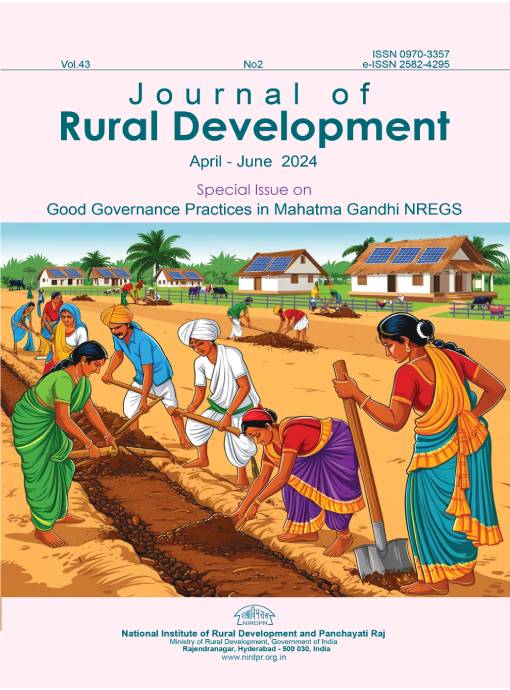
Women’s Participation in Mahatma Gandhi NREGS and Gender-Responsive Implementation: Progress and Persistent Challenges
DOI:
https://doi.org/10.25175/jrd/2024/v43/i2/173500Keywords:
MGNREGS, Gender-Responsive, Women’s Participation Trends.Abstract
This paper analyses the participation of women in the Mahatma Gandhi National Rural Employment Guarantee Scheme (Mahatma Gandhi NREGS) and examines the gender-responsive implementation of the programme. Using a descriptive research design and secondary data analysis, this study assesses trends in women’s participation, gender budgeting, resource allocation, and the potential benefits of Mahatma Gandhi NREGS assets for women. The findings reveal significant progress in women’s participation and highlight persistent challenges such as regional disparities, patriarchal norms, and inadequate facilities. To address these challenges, the paper recommends implementing the programme by incorporating women’s perspectives from the planning stages, selecting work that directly benefits women, and ensuring equitable resource allocation, which are crucial for enhancing gender responsiveness in the Mahatma Gandhi NREGS.
Downloads
References
Afridi, F., Mukhopadhyay, A., & Sahoo, S. (2016). Female Labor Force Participation and Child Education in India: Evidence from the National Rural Employment Guarantee Scheme. IZA Journal of Labor & Development, 5, 1-27.
Agarwal, B. (2010).Gender and Green Governance: The Political Economy of Women’s Presence Within and Beyond Community Forestry. Oxford University Press.
D Rajasekher and R Manjula (eds) (2024). Women Leadership, Decentralised Governance and Development: Perspectives from Indian States. Springer: Singapore.
D Rajasekhar (ed).(2022). Handbook of Decentralised Governance and Development in India, Routledge: London and New York.
Desai, S. 2018. Do Public Works Programs Increase Women’s Economic Empowerment: Evidence from Rural India. India Human Development Survey Working Paper 2018-02. Retrieved from https://ihds.umd.edu/sites/ihds.umd.edu/files/MGNREGApercent20percent26percent20Womenpercent27spercent20Econpercent20Empowerment_Oct per cent202018.pdf. Accessed 15 Dec 2022.
Desai, S., Vashishtha, P., & Joshi, O. (2015). Mahatma Gandhi National Rural Employment Guarantee Act: A Catalyst for Rural Transformation. National Council of Applied Economic Research.
Dulhunty, A. (2023). Women’s Empowerment and Microcredit Programmes in India: The Possibilities and Limitations of Self-Help Groups. Routledge.
Esteves, T., Rao, K. V., Sinha, B., Roy, S. S., Raut, S., Jha, A., & Watts, C. (2013). Agricultural and Livelihood Vulnerability Reduction through the MGNREGA. Economic and Political Weekly, 48(52), 94-103.
Hajam, F. A., Rather, J. A., &Hajam, L. A. (2021). A Study on Evaluation of Mahatma Gandhi National Rural Employment Guarantee Act in Rural India: A State Level Analysis. The Journal of Oriental Research Madras, 92, 158-170.
Holmes, R., Sadana, N., & Rath, S. (2011). An Opportunity for Change? Gender Analysis of the Mahatma Gandhi National Rural Employment Guarantee Act. Overseas Development Institute. https://www.odi.org/publications/6292-opportunity-change-gender-analysis-mahatma-gandhi-national-rural-employment-guarantee-act
Jayasaravanan, G., &Murugesan, P. (2018). Impact on Enhancing Livelihoods Opportunities in (MGNREGS) in Annagramam Block, Cuddalore District, Tamil Nadu. Asian Review of Social Sciences, 7(3), 58–62. https://doi.org/10.51983/arss-2018.7.3.1467
Khera, R., &Nayak, N. (2009). Women Workers and Perceptions of the National Rural Employment Guarantee Act. Economic and Political Weekly, 44(43), 49-57.
Koolwal, G., & Van de Walle, D. (2013).Access to Water, Women’s Work, and Child Outcomes. Economic Development and Cultural Change, 61(2), 369-405. https://doi.org/10.1086/668280
Kumar, S., & Madheswaran, S. (2020). Social Capital and Tapping Community-based Organisation’s Convergence Potential with MGNREGA: A Micro Study in Karnataka. Institute for Social and Economic Change.
Mehta, L., & Derman, B. (Eds.). (2017). Flows and Practices: The Politics of Integrated Water Resources Management in Eastern and Southern Africa. Weaver Press.
Meinzen-Dick, R., &Zwarteveen, M. (1998). Gendered Participation in Water Management: Issues and Illustrations from Water Users’ Associations in South Asia. Agriculture and Human Values, 15(4), 337-345. https://doi.org/10.1023/A:1007524829670
Ministry of Rural Development. (2021). MGNREGA Outcomes (2020-21). https://nregarep2.nic.in/netnrega/mgnrega_new/Nrega_home.aspx
Pankaj, A., & Tankha, R. (2010). Empowerment Effects of the NREGS on Women Workers: A Study in Four States. Economic and Political Weekly, 45(30), 45-55.
Rao, N. (2017). Assets, Agency and Legitimacy: Towards a Relational Understanding of Gender Equality Policy and Practice. World Development, 95, 43-54. https://doi.org/10.1016/j.worlddev.2017.02.018
Reddy, D. N., Reddy, A. A., & Bantilan, M. C. S. (2014). The Impact of Mahatma Gandhi National Rural Employment Guarantee Act (MGNREGA) on Rural Labor Markets and Agriculture. India Review, 13(3), 251-273.
Rodriguez, Z. (2022). The Power of Employment: Effects of India’s Employment Guarantee on Women Empowerment. World Development, 152, 105803.
Samaddar, J. (2020). MGNREGA and its Impact on Women Employment-Some Insights from Review of Literature. SJCC Management Research Review, 13-25.
Sorenson, S. B., Morssink, C., & Campos, P. A. (2011). Safe Access to Safe Water in Low-Income Countries: Water Fetching in Current Times. Social Science & Medicine, 72(9), 1522-1526. https://doi.org/10.1016/j.socscimed.2011.03.010
Sudarshan, RM (2011), ‘India’s National Rural Employment Guarantee Act: Women’s Participation and Impacts in Himachal Pradesh, Kerala and Rajasthan’, Research Report Summary 06, Institute of Development Studies.
Sultana, F. (2009). Fluid lives: Subjectivities, Gender, and Water in Rural Bangladesh. Gender, Place & Culture, 16(4), 427-444. https://doi.org/10.1080/09663690903003942
Tagat, A. (2020). Female Matters: Impact of a Workfare Program on Intra-Household Female Decision-Making in Rural India. World Development Perspectives, 20, 100246.
UN Women. (2012). The Role of Women in Rural Development, Food Production and Poverty Eradication 2012. United Nations.
UN Women. (2014).World Survey on the Role of Women in Development 2014: Gender Equality and Sustainable Development. United Nations.
Unni, J., & Rani, U. (2001). Social Protection for Informal Workers: Insecurities, Instruments and Institutional Mechanisms. Gujarat Institute of Development Research.
World Bank. (2017).World Development Report 2018: Learning to Realise Education’s Promise. The World Bank.
World Bank. (2017). World Development Report 2018: Governance and the Law. The World Bank.