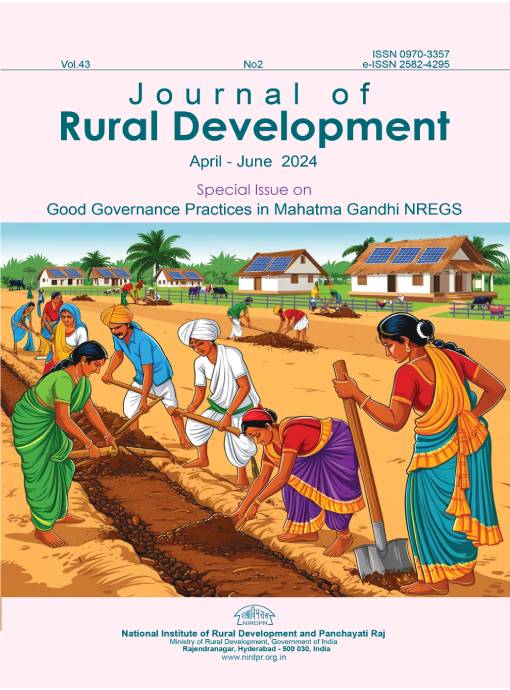
Mahatma Gandhi NREGS Benefits to Disadvantaged Groups: Status and Trends Across Major States of India
DOI:
https://doi.org/10.25175/jrd/2024/v43/i2/173505Keywords:
MGNREGS, Social Inclusion, Good Governance.Abstract
This paper analyses the extent to which the National Rural Employment Guarantee Scheme provided benefits to households belonging to Scheduled Caste (SC) and Scheduled Tribe (ST) categories across the major states in the country, with the help of secondary data on the scheme provided by the Ministry of Rural Development. In doing so, the paper focuses on social inclusion – an important aspect and component of good governance. The paper shows that Rajasthan, Kerala, Andhra Pradesh, and Telangana have been comparatively more successful states in reaching benefits for households belonging to SC and ST categories. The main contributing factor is good governance. On the other hand, in states where the population belonging to SC and ST categories is large, the success of the programme in delivering the benefits to these marginalised groups has not been significant due to poor governance. The paper offers a few suggestions on how to improve governance in the implementation of the scheme.
Downloads
References
Aggarwal, A. (2017). Tyranny of MGNREGA’s Monitoring System. Economic and Political Weekly, 52(37), 24–26.
Fernandes, Denzil (2015). Implementation of MGNREGA & Its Impact on Rural Madhya Pradesh, Indian Journal of Industrial Relations, 50 (3), 505-516.
Government of India (GoI) (2013). The National Rural Employment Guarantee Act 2005 (NREGA), Operational Guidelines 2013 (4th edition), Ministry of Rural Development, Government of India, New Delhi.
Government of India & CWEPA, NIRDPR (2014.) Mahatma Gandhi National Rural Employment Guarantee Act, 2005 (Mahatma Gandhi NREGA) – Frequently Asked Questions (FAQs) on MGNREGA Operational Guidelines-2013. New Delhi: Ministry of Rural Development, Government of India, https://nregaplus.nic.in/Netnrega/MGNREGA_new/NREGA_home_new.aspx
Government of India. (2008). The National Rural Employment Guarantee Act 2005 (NREGA), Operational Guidelines 2008 (3rd edition). New Delhi: Ministry of Rural Development, Government of India.
Goyal, A., Kumar, R., & Goyal, A. (2023). Is MGNREGA Inclusive of Scheduled Caste/Scheduled Tribe and Women? A Case Study of Haryana, India. Contemporary Voice of Dalit, https://doi.org/10.1177/2455328X231169638
Kumar, Sanjay and Kumari, Meena & Alam, Shamsher. (2018). Ground Realities and Inhibitions in Execution of MGNREGA in Jharkhand, India. Asian Journal of Research in Social Sciences and Humanities, 8(1), 74 - 93, Available at SSRN: https://ssrn.com/abstract=3275688
Lakha Salim, D Rajasekhar and R Manjula, (2015). Collusion, Cooption and Capture: Social Accountability and Social Audits in Karnataka, India, Oxford Development Studies, 43 (3), 330-348.
Manjula R. (2022). Implementing Workfare through Decentralised Government for Poverty Reduction. In D Rajasekhar edited. Handbook of Decentralised Governance and Development in India. Routledge: Oxford.
Manjula, R. (2024). Do People Participate in the Decentralised Planning of MGNREGS Works? Evidence from Karnataka. Journal of Social and Economic Development. https://doi.org/10.1007/s40847-024-00396-8
Manjula, R., & Rajasekhar, D. (2015). Participation of Scheduled Caste Households in MGNREGS: Evidence from Karnataka (Working Paper 339). Institute for Social and Economic Change, Bangalore.
Mishra, Pulak, Behera, Bhagirath & Nayak, Narayana Chandra (2010). A Development Delivery Institution for the Tribal Communities: Experience of the National Rural Employment Guarantee Scheme in India, Development Policy Review, 28 (4), 457-479.
Petrikova, I. (2020). Perpetuating Poverty through Exclusion from Social Programmes: Lessons from Andhra Pradesh. Oxford Development Studies, 48(1), 33–55. https://doi.org/10.1080/13600818.2019.1601173
Rajasekhar D., Salim Lakha & R. Manjula, (2013). How Effective are Social Audits under MGNREGS? Lessons from Karnataka, Sociological Bulletin, 62 (3), 431-455.
Rajasekhar, D., M. Devendra Babu & R. Manjula (2018a). Decentralised Governance, Development Programmes and Elite Capture, Springer, Singapore, 2018.
Rajasekhar D., M. Devendra Babu & R Manjula, (2018b) Quality of Governance in Grama Panchayats; Evidence from Karnataka, Journal of Rural Development, 37(4), 603-620.
Rawal, N. (2008). Social Inclusion and Exclusion: A Review. Dhaulagiri Journal of Sociology and Anthropology, 2, 161–180. https://doi.org/10.3126/dsaj.v2i0.1362
Shah, Deepak (2012). Implementation of NREGA in Maharashtra: Experiences, Challenges and Ways Forward. MPRA - Munich Personal RePEc Archive, MPRA Paper No. 39270.
Shah, Deepak (2016). Implementation of MGNREGA and Sustainable Livelihood Security in Maharashtra: A Region-wise Analysis. Indian Journal of Economics and Development, 12 (3), 461-468. DOI: 10.5958/2322-0430.2016.00162.1.
Sukhtankar, Sandip (2017). India’s National Rural Employment Guarantee Scheme: What Do We Really Know about the World’s Largest Workfare Program? In Karthik Muralidharan and Barry Bosworth (Eds.), The India Policy Forum 2016-17. https://www.ncaer.org/publication/india-policy-forum-2016-17.