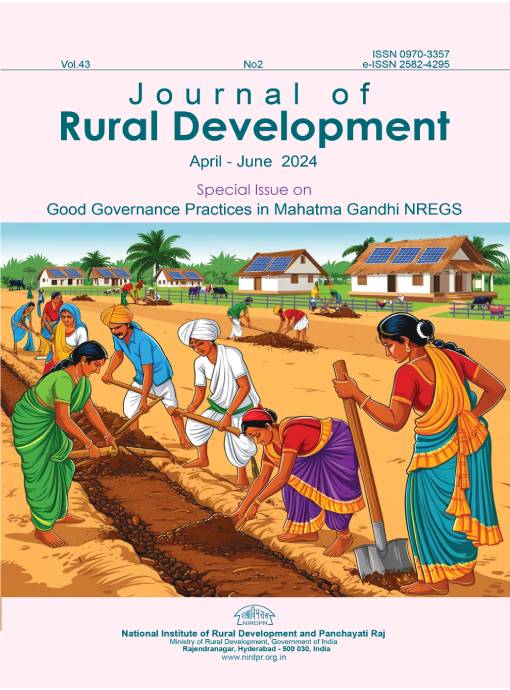
Natural Resource Management Under Mahatma Gandhi NREGS: Potential Impacts on Climate Change and Environmental Conservation
DOI:
https://doi.org/10.25175/jrd/2024/v43/i2/173507Keywords:
Natural Resources Management, Climate Adaptation, Climate Proofing.Abstract
Natural resource management is widely acknowledged for its crucial role in climate change adaptation and mitigation. It is achieved through sustainable use and conservation of resources by reducing greenhouse gas emissions through practices like afforestation, sustainable agriculture and water conservation. An attempt is made in this paper to evaluate the potential of natural resource-based activities under the Mahatma Gandhi National Rural Employment Guarantee Scheme across the nation on achieving climate resilience together with co-benefits in terms of climate adaptation and mitigation. The success stories in different parts of India reveal the gross improvement in carbon sequestration and crop productivity. Most of the undertaken activities have significantly enhanced the adaptive capacity of rural communities to climate change risks, yielding various ecological and environmental benefits through an advanced response to changing rainfall patterns, drought and flooding to reach the ultimate goal of securing resilience and sustainability of livelihoods. However, there is a need for further examination and quantification of its potential while emphasising that the scheme holds promise for a more resilient future.
Downloads
References
Abinash Mohanty & Shreya Wadhawan. (2021). Mapping India’s Climate Vulnerability, .A District Level Assessment. Council on Energy, Environment and Water. https://www.ceew.in/sites/default/files/ceew-study-on-climate-change-vulnerability-index-and-district-level-risk-assessment.pdf
Adger, W. N., P. M. Kelly, & N. H. Ninh (Eds). (2001). Living with Environmental Change: Social Resilience, Adaptation and Vulnerability in Vietnam. Routledge, London, UK.
Agarwal, P. K., Nagrale, B. G., & Chandel, B. S. (2015). Is MNREGA Affecting Availability, Wages and Cost of labour in Indian Agriculture? Discerning Quantitative Evidences. Indian Journal of Economics and Development, 11(4), 967-974.
Akbari, H., Pomerantz, M., & Taha, H. (2001). Cool Surfaces and Shade Trees to Reduce Energy Use and Improve Air Quality in Urban Areas. Solar energy, 70(3), 295-310.
Alam, M. S., Duraisamy, P., Siddik, A. B., Murshed, M., Mahmood, H., Palanisamy, M., & Kirikkaleli, D. (2023). The Impacts of Globalisation, Renewable Energy, and Agriculture on CO2 Emissions in India: Contextual Evidence Using a Novel Composite Carbon Emission-related Atmospheric Quality Index. Gondwana Research, 119, 384-401.
Anantha, K. H., Garg, K. K., Moses, D. S., Patil, M. D., Sawargaonkar, G. L., Kamdi, P. J., ... & Wani, S. P. (2021). Impact of Natural Resource Management Interventions on Water Resources and Environmental Services in Different Agroecological Regions of India. Groundwater for Sustainable Development, 13, 100574.
Angom, J., & Viswanathan, P. K. (2022). Contribution of National Rural Employment Guarantee Program on Rejuvenation and Restoration of Community Forests in India. Frontiers in Forests and Global Change, 5, 849920.
Bhat, J. A., & Yadav, P. (2015). MGNREGS: A Pathway for Achieving Sustainable Development. International Journal of Engineering Technology, Management and Applied Sciences, 3, 339-347.
Dinar, A., Tieu, A., & Huynh, H. (2019). Water Scarcity Impacts on Global Food Production. Global Food Security, 23, 212-226.
Downing, T. E. (2003). Lessons from Famine Early Warning and Food Security for Understanding Adaptation to Climate Change: Toward a Vulnerability/Adaptation Science? In Climate Change, Adaptive Capacity and Development (1–0, pp. 71–100). Imperial College Press, London, UK. https://doi.org/10.1142/9781860945816_0005
Fischer, H. W. (2020). Policy Innovations for Pro-Poor Climate Support: Social Protection, Small-Scale Infrastructure, and Active Citizenship under India’s MGNREGS. Climate and Development, 12(8), 689-702.
Folke, C., Carpenter, S., Elmqvist, T., Gunderson, L., Holling, C. S., & Walker, B. (2002). Resilience and Sustainable Development: Building Adaptive Capacity in a World of Transformations. AMBIO: A Journal of the Human Environment, 31(5), 437-440.
Gavali, R. S., Babu, V. S., Kakumanu, K. R., Mukate, S. V., Imran Khan, Y. D., Patil, B., ... & Rao, V. S. (2023). Scalable Adaptation Model for Sustainable Agriculture Livelihoods Under Changing Climate: A Case Study from Bihar and Madhya Pradesh. In The Palgrave Handbook of Socio-ecological Resilience in the Face of Climate Change: Contexts from a Developing Country, Springer Nature Singapore, 499-526.
Gavali, R. S., Shaikh, H. M. Y (2016). Estimation of Carbon Storage in the Tree Growth of Solapur University Campus, Maharashtra, India. International Journal of Science and Research, 5(4), 2364-2367.
Hangarge L. M., D. K. Kulkarni, V. B. Gaikwad, D. M. Mahajan and Nisha Chaudhari (2013) Carbon Sequestration Potential of Tree Species in Somjaichi Rai (Sacred Grove) at Nandghur Village, in Bhor Region of Pune District, Maharashtra State, India, Annals of Biological Research, 3(7), 3426-3429.
Herforth, A., Bai, Y., Venkat, A., Mahrt, K., Ebel, A., & Masters, W. A. (2020). Cost and Affordability of Healthy Diets Across and Within Countries: Background Paper for The State of Food Security and Nutrition in the World 2020. FAO Agricultural Development Economics Technical Study No. 9 (Vol. 9). Food & Agriculture Org.
Juschten, M., Reinwald, F., Weichselbaumer, R., & Jiricka-Pürrer, A. (2021). Developing an Integrative Theoretical Framework for Climate-Proofing Spatial Planning across Sectors, Policy Levels, and Planning Areas. Land, 10(8), 772.
Kareemulla, K., Ramasundaram, P., Kumar, S., & Rao, R. (2013). Impact of National Rural Employment Guarantee Scheme in India on rural poverty and food security. Current Agriculture Research Journal, 1(1), 13.
Kaur, N., Steinbach, D., Agarwal, A., & Manuel, C. (2017). Building Resilience to Climate Change MGNREGS and Climate-Induced Droughts in Sikkim. http://archive.nyu.edu/handle/2451/44184
Kraenzel, M., Castillo, A., Moore, T., & Potvin, C. (2003). Carbon Storage of Harvest-Age Teak (Tectona grandis) Plantations, Panama. Forest Ecology and Management, 173(1-3), 213-225.
Kraenzel , M., Castillo, A.D., Moore, T., & Potvin, C.K. (2009). Carbon Storage of Harvest-Age Teak (Tectonagrandis) plantations, Panama.
Kumar, N., & Maya, K. (2023). Impact of Mahatma Gandhi National Rural Employment Guarantee Act on Rural Credit System in India: A Standard Logit Difference in Difference Approach. Global Social Welfare. https://doi.org/10.1007/s40609-023-00282-x
Lee, T. C., Anser, M. K., Nassani, A. A., Haffar, M., Zaman, K., & Abro, M. M. Q. (2021). Managing Natural Resources through Sustainable Environmental Actions: A Cross-Sectional Study of 138 Countries. Sustainability, 13(22), 12475.
Macwan, B. K. S. Impact of MGNREGA in Building Climate Change Resilience in Western Dry Region, Rajasthan. Disaster Development, 61.
Madappa, T., Kargwal, K., Mathew, S., & Murthy, I. K. (2023). A Framework for Quantifying the Climate Co-Benefits of Development Programmes (G. Singh, Ed.). Center for Study of Science, Technology and Policy.
Mitali Banerjee Joyee. (2024, May 9). Purulia Farm Transforms Barren Land into Green Oasis. The Village Square. https://www.villagesquare.in/purulia-farm-transforms
Murthy, I. K., Gupta, M., Tomar, S., Munsi, M., Tiwari, R., Hegde, G. T., &Ravindranath, N. H. (2013). Carbon Sequestration Potential of Agroforestry Systems in India. J Earth Sci Climate Change, 4(1), 1-7.
Nalgire, S., & Chinnasamy, P. (2022). Index-Based Impact Monitoring of Water Infrastructures in Climate Change Mitigation Projects: A Case Study of MGNREGS-IWMP Projects in Maharashtra. Frontiers in Water, 4, 956161.
Noori, A. R., & Singh, S. K. (2023). Rainfall Assessment and Water Harvesting Potential in an Urban Area for Artificial Groundwater Recharge with Land Use and Land Cover Approach. Water Resources Management, 37(13), 5215-5234.
PIB. (2023, July 14). Union Home Minister and Minister of Cooperation, Shri Amit Shah Inaugurates the National Mega Conclave on FPO in the Cooperative Sector and Releases the Action Plan for Formation of 1100 new FPOs by PACS in New Delhi Today [Press Release], https://pib.gov.in/PressReleseDetailm.aspx?PRID=1939473
Puja Das. (2023, May 31). Nearly 55 per cent of farmland getting irrigation: NITI Aayog’s Chand, LiveMint. https://www.livemint.com/news/india/nearly-55-of-farm-land-getting-irrigation-niti-aayog-s-chand-11686456912293.html
Ravindranath, N. H., & Murthy, I. K. (2021). Mitigation Co-Benefits of Carbon Sequestration from MGNREGS in India. Plos one, 16(5), e0251825.
Ribot, J. C., Magalhães, A. R., & Panagides, S. S. (Eds.) (1996). Climate Variability, Climate Change and Social Vulnerability in the Semi-arid Tropics. Cambridge University Press. https://doi.org/10.1017/CBO9780511608308
Sharma, J., & Ravindranath, N. H. (2019). Applying IPCC 2014 Framework for Hazard-Specific Vulnerability Assessment under Climate Change. Environmental Research Communications, 1(5), 051004.
Singh, S. (2016). Evaluation of the World’s Largest Social Welfare Scheme: A Non-Parametric Assessment. Evaluation and Program Planning, 57, 16-29.
Smit, B., Pilifosova, O., Burton, I., Challenger, B., Huq, S., Klein, R., Yohe, G., Adger, W., Downing, T., & Harvey, E. (2001). Adaptation to Climate Change in the Context of Sustainable Development and Equity. In J. McCarthy, O. Canziani, N. Leary, D. Dokken, & K. White (Eds.), Climate Change 2001: Impacts, Adaptation and Vulnerability (pp. 877–912). Cambridge University Press.
Smith, K. R., & Sagar, A. (2014). Making the clean available: escaping India’s Chulha Trap. Energy Policy, 75, 410-414.
Tittonell, P., & Giller, K. E. (2013). When Yield Gaps are Poverty Traps: The Paradigm of Ecological Intensification in African Smallholder Agriculture. Field Crops Research, 143, 76-90.
Tiwari, K. R., Bajracharya, R. M., Raut, N., & Sitaula, B. K. (2017). Agroforestry System: An Opportunity for Carbon Sequestration and Climate Change Adaptation in the Mid-Hills of Nepal. Octa Journal of Environmental Research, 5(1).
Turangi, S. (2022). Social Protection through MGNREGS: A Study of Rayalaseema Region in Andhra Pradesh. Journal of Rural Development, 41(1), 102-119.
Umachagi, A. E., & Tejashwini, K. C. (n.d.). Action Plan of KSAPCCS in Implementation of Agriculture and Water Sector in Connection with Environmental Change of Livelihood of Farmers. https://www.multiresearchjournal.com/admin/uploads/archives/archive-1675798589.pdf
Vempati, A. V., Aswath, G. I., Radhakrishnan, S., Rajan, R. A., Kothurkar, N. K., Frey, L. M., & Nandanan, K. (2020, December). Agricultural Problems and Technology-based Sustainable Solutions for an Impoverished Village of Bihar, India. In 2020 IEEE 8th R10 Humanitarian Technology Conference (R10-HTC) (pp. 1-5). IEEE.
Verma, R.K., Pandey, A.K., Verma, S., & Mishra, S.K. (2023). A Review of Environmental Flow Assessment Studies in India with Implementation Enabling Factors and Constraints. Ecohydrology & Hydrobiology.
Walker, B., & Salt, D. (2012). Resilience Practice: Building Capacity to Absorb Disturbance and Maintain Function. Island Press.
Wendiro, D., Wacoo, A. P., & Wise, G. (2019). Identifying Indigenous Practices for Cultivation of Wild Saprophytic Mushrooms: Responding to the Need for Sustainable Utilisation of Natural Resources. Journal of Ethnobiology and Ethnomedicine, 15, 1-15.
Yadav, P., Jha, R. K., Parasriya, R., Toushif, P. K., Jain, V., & Mallesh, Y. (2024). MGNREGA-Assisted Afforestation for Climate Moderation in India: An Overview. International Journal of Environment and Climate Change, 14(2), 310-321.